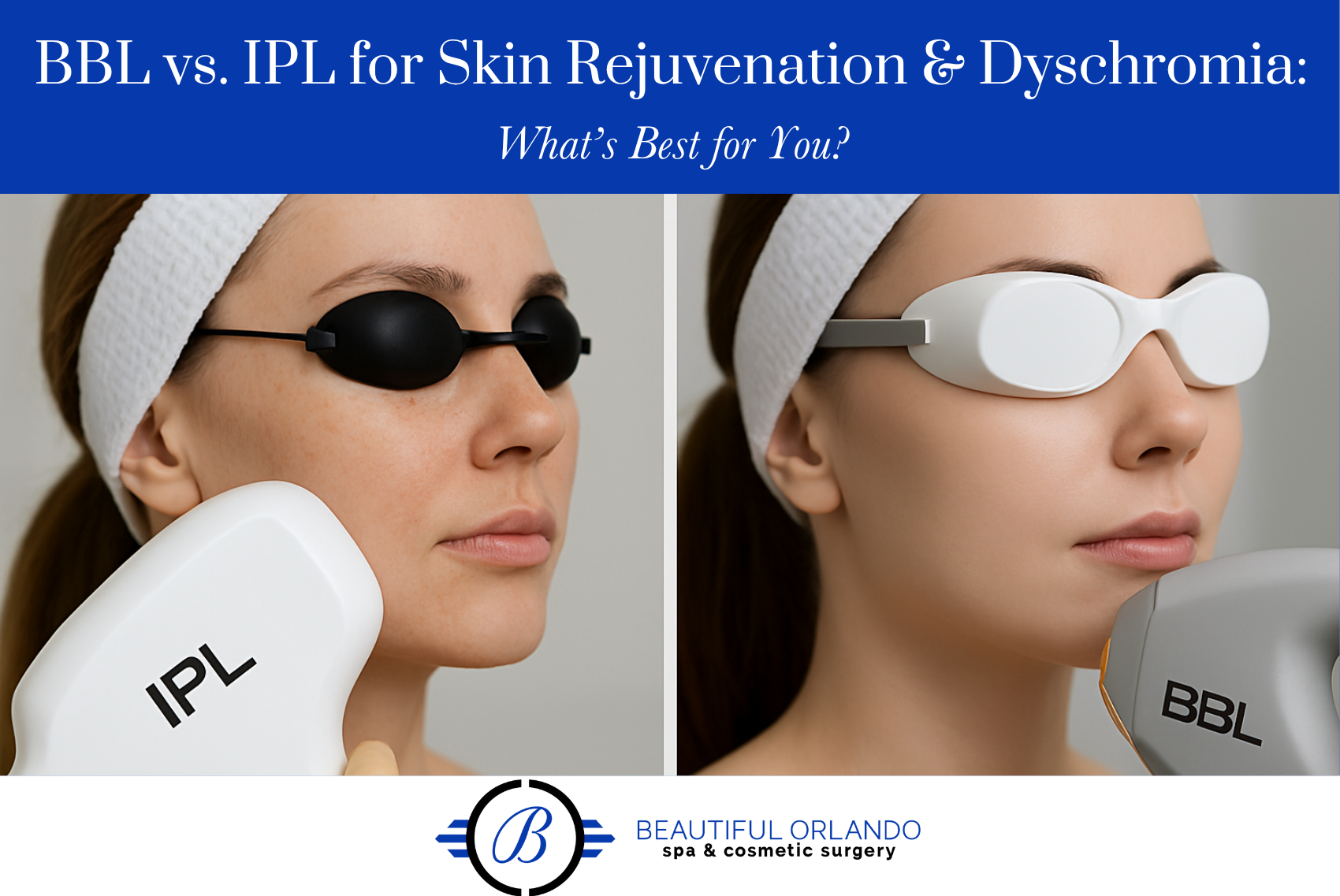
If sunspots, redness, or uneven skin tone are keeping you from loving your complexion, light-based therapies can help. At Beautiful Orlando Spa & Cosmetic Surgery in Kissimmee, we offer advanced options to correct dyschromia (color irregularities like brown spots, melasma-like discoloration, and diffuse redness) while refreshing overall skin quality. Two of the most requested treatments are BroadBand Light (BBL) and Intense Pulsed Light (IPL).
Below, we break down how each works, the differences, ideal candidates, what to expect, and answer the most common questions so you can choose with confidence.
Quick Take: The Difference in One Minute
- IPL is the well-known, effective “photofacial” technology that uses broad-spectrum, filtered light to address pigment and redness.
- BBL is a newer, more sophisticated form of IPL (not a laser) that offers finer control of wavelengths, pulse duration, and energy, often resulting in more precise targeting, fewer sessions, and customization for various skin types and concerns.
What Is Dyschromia?
Dyschromia refers to uneven skin color—including sun damage (lentigines), post-inflammatory dark marks after acne, mottled redness from broken capillaries or rosacea-like flushing, and overall dullness. Treating dyschromia improves clarity, luminosity, and uniformity of the skin.
How IPL Works
Intense Pulsed Light delivers broad-spectrum light through filters that selectively target chromophores:
- Brown pigment (melanin): sunspots, age spots
- Red pigment (hemoglobin): facial veins, redness
The absorbed light converts to heat, breaking up pigmented spots and collapsing tiny vessels so the body can naturally clear them.
Best for: Sunspots, freckles, mild redness, photoaging on face, neck, chest, hands.
How BBL Works (And Why It’s Considered “Next-Gen” IPL)
BroadBand Light is a branded, advanced IPL platform engineered for high customization:
- Multiple, precise filters and dual-lamp technology for consistent energy delivery
- Adjustable pulse widths and cooling for comfort and safety
- Targeted protocols (e.g., for vascular vs. pigment emphasis)
- Often used in “Forever Young” maintenance programs to help sustain clarity and tone
Best for: Complex or mixed dyschromia (red + brown), diffuse redness, stubborn sun damage, texture dullness, and ongoing photo-maintenance.
BBL vs. IPL: Side-by-Side
| Feature | IPL Photofacial | BBL (Advanced IPL) |
| Technology | Broad-spectrum light with filter(s) | Advanced IPL with enhanced filtering, pulse control, cooling |
| Customization | Good | Excellent (fine-tuned settings for precision) |
| Comfort | Mild “rubber-band snap” | Similar or more comfortable due to cooling |
| Sessions | 3–5 typical | 2–4 typical (varies by concern/skin) |
| Downtime | Minimal; brown spots darken then flake | Minimal; similar darkening/peppering before clearing |
| Targets | Browns, reds, photoaging | Browns, reds, photoaging, mixed dyschromia; great for maintenance |
| Areas | Face, neck, chest, hands, arms | Face, neck, chest, hands, arms; highly adaptable |
Note: Actual number of sessions varies by skin type, concern severity, and treatment plan.
Who Is a Good Candidate?
- Skin types I–III: Usually eligible for both IPL and BBL.
- Skin types IV–V: BBL’s precision may expand eligibility, but careful settings and provider expertise are essential.
- Skin type VI: Options may be more limited; alternative treatments or very conservative protocols may be recommended.
Recent tan, active infections, pregnancy, certain photosensitizing medications, or history of keloids may affect candidacy. We’ll review your history and goals in your consultation.
Treatment Experience, Results & Maintenance
- During treatment: You’ll wear eye protection. Expect quick light pulses and mild warmth or snapping sensations. Sessions typically take 15–30 minutes for the face.
- Right after: Mild redness or swelling for a few hours. Brown spots often look darker (“peppering”) for 3–7 days before gently flaking.
- Results: Most see clearer, brighter skin after the first session, with progressive improvement over a series spaced 3–4 weeks apart.
- Maintenance: Sun exposure drives dyschromia. Many patients schedule seasonal or quarterly BBL sessions to preserve clarity and reduce new sun spots.
Pre- & Post-Care Essentials
Before:
- Avoid sun/tanning/self-tanner 2–4 weeks.
- Pause retinoids/exfoliants 3–5 days prior (as advised).
- Arrive with clean skin (no makeup or heavy skincare).
After:
- Gentle cleanser, moisturizer, SPF 30+ daily.
- Do not pick flaking spots—let them shed naturally.
- Avoid hot yoga/sauna for 24–48 hours and follow your provider’s guidance on when to resume actives.
Can BBL or IPL Treat Melasma?
Melasma can be triggered by heat and light, so we proceed carefully. In some cases, conservative protocols or non-light options (topicals, chemical peels, microneedling with specific serums) may be better or combined with BBL/IPL strategically. We’ll tailor a plan to minimize rebound.
Complementary Treatments
- Medical-grade skincare: Vitamin C, pigment inhibitors, sunscreen for prevention and maintenance
- Chemical peels: For fine flaking and brightness between light sessions
- Microneedling/RF microneedling: For texture, pores, and acne scarring (not for active redness)
- Laser vascular treatments: For more prominent veins if needed
Comprehensive Q&A
Q: Is BBL a laser?
A: No. BBL is an advanced IPL system (broadband light), not a single-wavelength laser. Its strength is in multi-filter precision and custom pulse control.
Q: Which clears brown spots faster—BBL or IPL?
A: Many patients observe quicker or more noticeable clearing with BBL due to its tunability, though both are effective. Your results depend on spot depth, skin type, and number of sessions.
Q: Will my spots come back?
A: Treated spots clear, but new sun exposure can create new ones. Consistent SPF and maintenance sessions help sustain clarity.
Q: Can either treatment fix redness from rosacea?
A: Both can reduce facial redness and small vessels. BBL’s precision often makes it a favorite for diffuse, persistent redness. Ongoing maintenance is common.
Q: How many sessions will I need?
A: Typically 2–5 sessions spaced 3–4 weeks apart. Stubborn or mixed dyschromia may need more, followed by maintenance a few times per year.
Q: What downtime should I expect?
A: Minimal. You might see temporary redness and darkening of brown spots that flake over several days. Most people resume normal activities the same day.
Q: Is it safe for darker skin tones?
A: With conservative settings and experienced providers, some darker skin types may be candidates—especially with BBL. Safety screening is essential to minimize risk of hypo/hyperpigmentation.
Q: Can I do this if I’m on acne medications or using retinoids?
A: It depends. We may ask you to pause retinoids briefly and review other medications to avoid sensitivity. We’ll advise during your consult.
Q: Will it help pores and texture?
A: These are light-assisted therapies primarily for color, but many patients notice brighter tone and smoother look. For stronger texture/pores/scars, we might add microneedling or laser.
Q: How is the comfort level?
A: Most describe a quick snap and warmth; built-in cooling (especially with BBL) helps. Topical numbing is rarely needed.
Q: Is there anyone who shouldn’t get IPL/BBL?
A: Those who are currently tan, pregnant, on certain photosensitizing meds, or with active infections or recent intense sun exposure may be advised to wait or choose alternatives.
Q: How do I choose between IPL and BBL?
A: If you have mixed concerns (reds + browns), want fewer sessions, or have tricky areas, BBL often wins for flexibility and precision. If your needs are straightforward and budget-conscious, IPL remains an effective classic. We’ll recommend what fits your skin, goals, and timeline.
Ready for Clear, Even Skin?
Beautiful Orlando Spa & Cosmetic Surgery
Address: 1056 E Osceola Pkwy, Kissimmee, FL 34744
Phone: (407) 766-6080
Website: beautifulorlando.com
Book Online: Request an Appointment
Our experts will evaluate your skin, discuss BBL vs. IPL, and craft a plan for lasting clarity and glow. Bring your questions—we love to educate and guide you to the right choice.
Disclaimer: This blog is for educational purposes and does not replace personalized medical advice. Individual results vary.